
Why Every Indian MBA Marketing Student Needs This Roadmap
If you are an MBA or BBA student specializing in marketing, you have probably asked yourself this question at least once: “I have the degree, so why don’t I have a job offer yet?”
This is a familiar story for thousands of students across India, from top B-schools to smaller colleges in tier 2 and tier 3 cities. Campus placements come and go, LinkedIn is full of “excited to announce” posts from classmates, and it can feel like everyone except you has figured out the plan. That gap is exactly what this roadmap addresses.
In the live webinar “College Se Job Tak: Marketing Career Roadmap 2026,” Chandan Gupta, founder of MarkeTech by Chandan, breaks down what has actually changed in the marketing industry since 2014, why textbook marketing no longer matches what Indian recruiters hire for, and the exact phase by phase path from classroom to your first marketing job in 2026.
This article summarizes the full session, timestamped for easy navigation, along with an embedded recording, a breakdown of the 6 phase career roadmap, and answers to the most common questions Indian MBA and BBA marketing students ask about starting their careers.
Watch the Full Webinar
Session Overview and Timestamps
| Time | Section |
| 00:00 | Opening and why this session matters for MBA/BBA marketing students |
| 01:14 | Chandan Gupta’s background, 11+ years in digital marketing |
| 02:17 | Why marketing needed a fresh 2026 roadmap |
| 03:28 | Audience check in: where students are in their journey |
| 05:02 | The real gap between degrees and employability |
| 05:25 | How marketing jobs evolved from traditional to performance based |
| 1:06:37 | Building resumes and case studies that show impact |
| 1:06:50 | The 6 phase career growth roadmap |
| 1:07:54 | Setting your 12 month focus goal |
| 1:08:50 | Closing thoughts and Q&A |
Who Is Chandan Gupta?
Chandan Gupta completed his MBA in 2013 and moved into digital marketing in 2014, right as the field was beginning to shift away from traditional advertising in India. With more than 11 years of hands on industry experience, he built MarkeTech by Chandan to give MBA and BBA students the practical, real world guidance that most Indian college curriculums simply do not cover. Instead of repeating outdated textbook theory, the session focuses on what Indian companies are actually hiring for in 2026.
Why Marketing Needed a New Roadmap for 2026
Marketing in India in 2026 looks almost nothing like it did a decade ago. AI driven campaign tools, performance marketing, and data led decision making have replaced much of what used to be guesswork heavy traditional advertising. Yet most MBA and BBA curriculums have not caught up with this shift.
This creates a widening gap between what is taught in the classroom and what recruiters expect on day one. It is one of the main reasons many marketing graduates in India struggle to convert a good degree into a good job offer, even from well known institutes.
The Real Gap: Degree vs. Employability
A degree alone rarely gets you hired anymore, whether you studied at a metro city B-school or a college in a smaller town. The session breaks employability down into three distinct layers.
- Theoretical Knowledge, which is what you learn in classrooms and textbooks.
- Practical Skills, which are the tools and platforms you can actually operate, such as Meta Ads Manager, Google Ads, analytics dashboards, SEO tools, and AI assisted marketing tools.
- Proof of Work, which is a portfolio of real projects, campaigns, or case studies that show you can apply those skills.
Most students stop at the first layer. The ones who get hired build all three, and Indian recruiters in 2026 are actively screening for proof of work on LinkedIn and resumes, not just marks or certificates.
How Marketing Jobs Have Evolved
Traditional marketing such as pamphlets, newspaper ads, and TV commercials was built around reach and brand recall, with results that were hard to measure. Today’s marketing roles in India are performance based. Every rupee spent is trackable, every campaign is measured against ROI, and marketers are expected to justify decisions with data rather than gut feeling.
Building a Resume That Actually Gets Shortlisted
Instead of listing responsibilities, your resume and portfolio should highlight impact using this three part structure.
- Why the action was taken, meaning the problem or objective.
- How it was executed, meaning the strategy, tools, and process used.
- What was measurably achieved, meaning the result, ideally with numbers.
A single well documented case study, even one built from a college project, a college fest, an internship, or your own Instagram page, often carries more weight with an Indian recruiter than a long list of unproven skills on a resume.
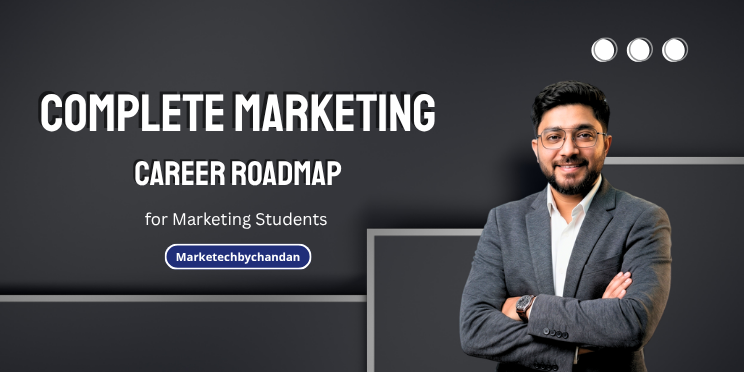
The 6 Phase Marketing Career Roadmap (2026)
This is the core framework from the session, a step by step path from college to a sustainable marketing career in India.
Phase 1: Degree and Core Fundamentals Complete your MBA or BBA and build a solid grounding in core marketing concepts such as consumer behavior, the marketing mix, branding, and market research.
Phase 2: Digital and AI Skill Acquisition Learn the practical tools of modern marketing, including Google Ads, Meta Ads, SEO, analytics platforms, and the AI assisted marketing tools that are now standard across Indian agencies and startups.
Phase 3: Practical Projects and Portfolio Building Apply what you have learned to real or simulated projects, such as running a personal Instagram page, managing a college fest campaign, or helping a small local business with its social media, and document the results properly.
Phase 4: Internships, Freelance Work, or First Job Use your portfolio to land your first real world exposure, whether it is a paid internship, an unpaid one, or freelance work, to build credibility and understand how the industry actually operates.
Phase 5: Domain Specialization Choose a specific lane, such as Meta Ads, Google Ads, SEO, marketing analytics, or brand marketing, and go deep in that area instead of staying a generalist.
Phase 6: Leadership and Team Management As experience grows, move from executing campaigns yourself to managing strategy, budgets, and teams.
Your Next Step: Set a 12 Month Focus Goal
Rather than trying to learn everything at once, the session encourages students to pick one focus area for the next 12 months, whether that is Digital Marketing, Marketing Analytics, Brand Marketing, or broader strategy, and go deep on it. Depth in one domain builds a stronger, more hireable profile than shallow knowledge spread across many areas, and it also gives you a clear, honest answer the next time someone asks what you actually want to do.
Frequently Asked Questions
What is the “College Se Job Tak” marketing roadmap?
Why do MBA marketing graduates in India struggle to get jobs despite having a degree?
What skills should MBA marketing students learn in 2026?
What is “proof of work” in marketing, and why does it matter?
How is traditional marketing different from performance marketing?
Should a marketing student specialize or stay a generalist?
Who is Chandan Gupta?
A marketing degree gets you in the room, but skills and proof of work get you the offer. If you are an Indian MBA or BBA student unsure where to start, follow the six phase roadmap above, pick one 12 month focus area, and start building your portfolio today, even if it is small.