
AI tools are transforming the way businesses approach marketing. From writing blog posts and generating images to automating emails and analyzing customer data, artificial intelligence has become part of almost every digital marketing workflow.
This rapid adoption has sparked one of the biggest questions in the industry:
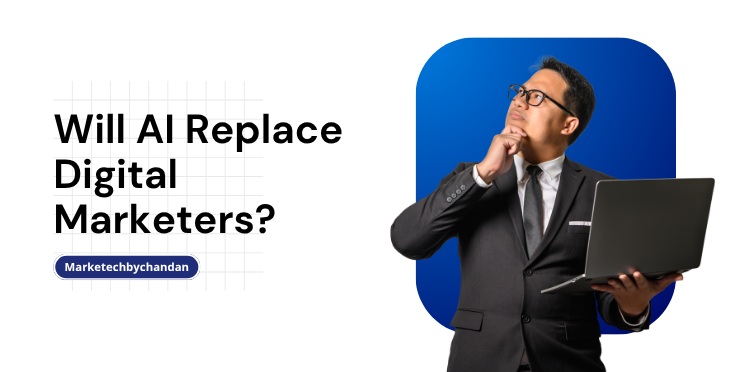
Will AI replace digital marketers?
The short answer is no, but it will change the way marketers work forever.
Understanding how AI and human expertise complement each other is the key to succeeding in the future of marketing.
What Is AI in Digital Marketing?
Artificial intelligence in digital marketing refers to the use of machine learning and automation tools to perform tasks that traditionally required human effort. These tools help businesses improve efficiency, save time, and make data-driven decisions.
Today, AI can:
- Write content drafts and outlines
- Generate images and creatives
- Automate email campaigns
- Create ad copy variations
- Analyze customer behavior
- Recommend products
- Personalize user experiences
- Identify trends from large datasets
As these capabilities continue to improve, many professionals worry about whether their jobs are at risk.
Will AI Replace Digital Marketers?
No. AI is unlikely to replace digital marketers entirely.
Instead, it will replace repetitive and time-consuming tasks while increasing the importance of strategic thinking, creativity, and human understanding.
The future belongs to marketers who know how to work alongside AI rather than compete against it.
What AI Does Extremely Well
Artificial intelligence excels in areas that involve speed, automation, and data processing.
- Automation – AI can automate repetitive activities such as email sequences, audience segmentation, reporting, and campaign optimization.
- Data Analysis – Modern marketing generates enormous amounts of data. AI can identify patterns and insights much faster than humans.
- Content Assistance – AI tools can help generate ideas, outlines, headlines, ad variations, and first drafts, improving productivity.
- Personalization – AI enables businesses to deliver personalized recommendations and experiences based on customer behavior.
- Efficiency – Tasks that once took hours can now be completed in minutes, allowing marketers to focus on higher-value activities.
Where AI Still Falls Short
Despite its impressive capabilities, AI has major limitations.
- Human Emotions – AI does not truly understand empathy, emotions, or emotional triggers.
- Cultural Nuance – Marketing messages that work in one region or audience may fail in another. Human judgment is essential.
- Creativity – AI predicts patterns based on existing data. Original ideas and breakthrough campaigns often come from human imagination.
- Storytelling– Great marketing tells stories that inspire action. Authentic storytelling remains a uniquely human skill.
- Customer Psychology – Understanding fears, motivations, desires, and trust requires emotional intelligence that AI cannot genuinely replicate.
Why Human Creativity Still Matters
The most successful marketing campaigns are not built on automation alone.
They succeed because they connect with people.
Customers remember brands that make them laugh, inspire them, solve their problems, or make them feel understood.
Elements such as:
- Trust
- Emotion
- Humor
- Brand voice
- Authenticity
- Storytelling
continue to drive meaningful customer relationships.
These strengths remain deeply human.
The Real Future of Marketing
The future of digital marketing is not AI versus humans.
It is AI plus humans.
AI will handle repetitive processes, while marketers focus on strategy and innovation.
The marketers who thrive in the coming years will develop skills such as:
- Strategic thinking
- Communication
- Branding
- Consumer psychology
- Creative problem-solving
- Relationship building
- AI tool proficiency
These professionals will become even more valuable as technology evolves.
The Biggest Mistake Businesses Make
Some organizations believe AI tools can completely replace marketing expertise.
This often leads to generic content, repetitive messaging, and campaigns that fail to differentiate the brand.
Tools without strategy rarely create exceptional results.
Businesses that combine technology with experienced marketers gain the greatest competitive advantage.
How Digital Marketers Can Stay Relevant
If you’re worried about AI replacing your role, focus on becoming adaptable.
- Learn AI Tools – Understand how to use AI to improve productivity rather than fear it.
- Build Strategic Skills – Learn how to create marketing plans, customer journeys, and growth strategies.
- Strengthen Creativity – Develop ideas that stand out and build emotional connections.
- Understand Human Behavior – Study psychology, consumer behavior, and communication.
- Keep Learning – Digital marketing changes constantly. Continuous learning is your biggest advantage.
Final Thoughts
AI is changing digital marketing faster than ever before.
However, successful marketing has always been about understanding people, solving problems, and building trust.
Artificial intelligence can automate tasks and accelerate execution, but it cannot replace genuine human creativity, empathy, strategic thinking, and decision-making.
The future does not belong to AI alone.
It belongs to marketers who know how to combine technology with intelligent strategy.
Instead of asking, “Will AI replace digital marketers?” perhaps the better question is:
Are digital marketers ready to evolve with AI?
Those who adapt won’t become obsolete. They’ll become indispensable.
Frequently Asked Questions (FAQs)
AI is expected to automate repetitive tasks, but it is unlikely to replace digital marketers entirely. Human creativity, strategy, and emotional intelligence remain essential.
AI can assist with content creation, data analysis, personalization, and automation. However, it still requires human oversight and strategic direction.
Yes. Digital marketing remains a strong career choice, especially for professionals who combine marketing expertise with AI skills.
Marketers should focus on strategy, branding, communication, psychology, creativity, and learning how to use AI tools effectively.
Explore these useful links and articles to deepen your understanding of digital marketing and expand your knowledge.
Introduction to Digital Marketing